
DJI · Documentary analysis
DJI Power Auro 2000 Elite
Main strength
Its 2016 Wh describe how much energy it stores. The 2000 W describe the total power of appliances connected to its sockets; these are two different limits. Runtime depends on consumption and losses.
Last documentary review
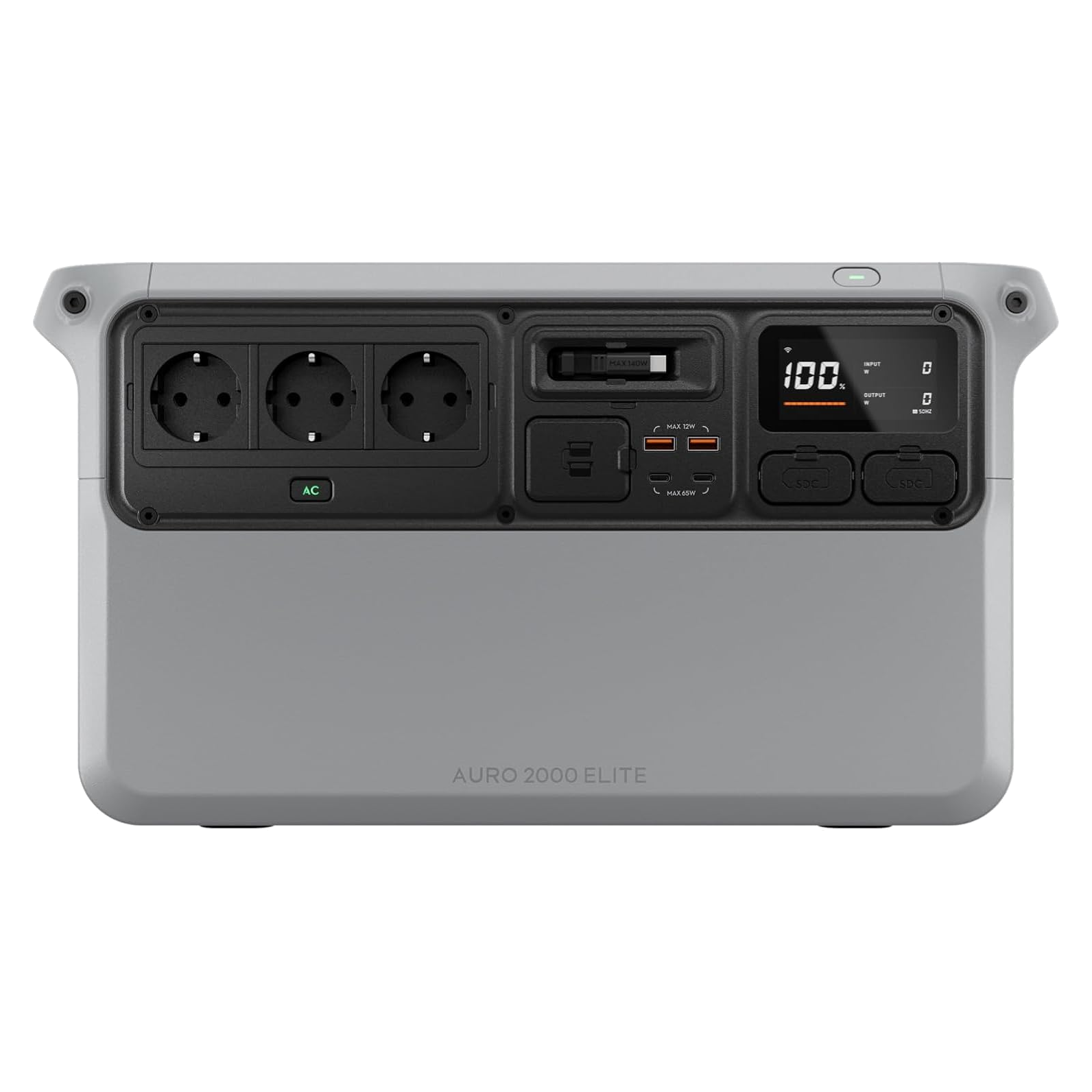
Official sources reviewed: 2026-11-01. Continental EU;220–240 V AC, 50/60 Hz, three Schuko sockets We have not carried out physical tests.
Who it may suit
Consider it if you need a reserve around 2 kWh for a camper or power cut. Enter your appliances and usage hours; then check cables, connections and startup. For a fridge, configure continuous AC mode.
When to look elsewhere
If you only need to charge small devices for a few hours, compare a lighter battery. Motor startup, equipment that cannot tolerate interruptions and specific solar-panel connections require additional checks.
Main trade-off
It weighs about 19 kg. Solar panels and the MC 4 solar cable are not included, nor is the direct-battery cable for fast vehicle charging. The retractable USB-C cable is built in.
What we know
Fields with documentation: nominal capacity, continuous AC power, chemistry, declared cycles, weight, dimensions, maximum solar input, AC sockets, number of USB ports, DC/USB output limits, connection features, EPS/UPS transfer time. Each field retains its limits; this does not verify the whole model.
View sources and variant ↓What needs checking
Your setup still needs checking: startup, cables, ports and simultaneous use, operating conditions and solar installation. The offer, package contents, final price and availability are checked separately.
Next step: check your consumption and appliance connections; nominal capacity alone does not establish compatibility.
- Nominal capacity
- 2016 Wh
- Continuous AC power
- 2000 W
- Weight
- 19 kg
- Maximum solar input
- 1200 W
Documentary criteria, not a physical test or certified compatibility with your appliances.
How we assess options →Connections: documented ports, voltages and limits ↓
Documented limits of the reviewed variant. Port power does not guarantee your appliance's protocol, cable or start-up. Shared groups limit the sum of loads.
2 × USB-C PD 3.0:up to 65 W per port · up to 65 W per port
5 / 9 / 12 / 15 / 20 V. Up to 5 A.
At the requested voltage:5 V: up to 25 W (5 A) · 9 V: up to 45 W (5 A) · 12 V: up to 60 W (5 A) · 15 V: up to 64.5 W (4.3 A) · 20 V: up to 65 W (3.25 A). Documentary verification:2026-11-01. This does not verify negotiation, cable or simultaneous use.
Documentary limits reviewed: 2026-11-01; these are not physical tests.
Official specifications for DJI Power Auro 2000 Elite · USB-C PD 3.0:up to 65 W per port ↗1 × Retractable USB-C PD 3.1 cable:up to 140 W · up to 140 W per port
5 / 9 / 12 / 15 / 20 / 28 V. Up to 5 A.
At the requested voltage:5 V: up to 25 W (5 A) · 9 V: up to 45 W (5 A) · 12 V: up to 60 W (5 A) · 15 V: up to 75 W (5 A) · 20 V: up to 100 W (5 A) · 28 V: up to 140 W (5 A). Documentary verification:2026-11-01. This does not verify negotiation, cable or simultaneous use.
Documentary limits reviewed: 2026-11-01; these are not physical tests.
Official specifications for DJI Power Auro 2000 Elite · Retractable USB-C PD 3.1 cable:up to 140 W ↗2 × USB-A:5 V and 2.4 A, up to 12 W per port · up to 12 W per port
5 V. Up to 2.4 A.
Documentary limits reviewed: 2026-11-01; these are not physical tests.
Official specifications for DJI Power Auro 2000 Elite · USB-A:5 V and 2.4 A, up to 12 W per port ↗
Charging and power: conditions that change the decision ↓
- Mains recharge of the whole battery
- Charging verification pending. This is a manufacturer claim under its stated conditions, not our own measurement. It is not the time to replenish your daily consumption.
- Solar input
- Documented maximum: 1200 W. Check the voltage window, current, connectors and accessories in the source. Peak sun hours describe equivalent energy, not clock hours at constant maximum power.
- Start-up and special modes
- Transient peak verification pending. Special modes may reduce voltage; they do not replace continuous power.
- Power supply continuity
- UPS: up to 10 ms; check your load. An EPS/UPS function with interruption does not establish medical continuity or compatibility with all sensitive equipment.
What do watts and watt-hours represent?
The W describe power at a given moment; Whdescribe accumulated energy. Multiplying an appliance's power by its usage hours estimates energy: 100 W for 2 hours is 200 Wh consumed by the appliance. Losses mean the battery must supply more.
Phone or tablet: 15 W × 2 h = 30 Wh
Illustrative load; check charger and USB protocol.
Router: 12 W × 8 h = 96 Wh
Hypothetical constant power; confirm the power supply.
LED light: 10 W × 4 h = 40 Wh
Example of one light; add the others if used simultaneously.
Compressor fridge: 45 W × 4 h = 180 Wh
Four hours of compressor operation, not four clock hours or measured consumption.
Illustrative power and hours, not measurements of your appliances or verified runtime of this station. These Wh represent appliance consumption before losses. Check each appliance's port, voltage, protocol and start-up requirements.
Formulas and assumptions for the AC example ↓
In the example of 100 W for 2 hours, the battery would supply around 265 Wh: AC consumption ÷ 85% efficiency, plus 15 illustrative inverter watts over those two hours.With90% of the2016documented nominal Wh available, such a constant load would give approximately13.7 hours. Formula: capacity ×0.9 ÷ (100 ÷ 0.85 + 15).
Battery margin, losses and inverter consumption are planning assumptions, not measurements of this model. Temperature, ageing and variable consumption may change the result. Do not apply this AC example directly to USB or DC.
400 W of panels: generation and solar example ↓
This is nominal generation power. With 4 peak sun hours and 75% assumed solar efficiency, the example is 400 W × 4 PSH × 0.75 = 1200 Wh. This is energy equivalent to six uses of the 100 W, two-hour example before output losses, not six guaranteed uses.
ForDJI Power Auro 2000 Elite, also applying the documented solar maximum limits the example's power to400W and its indicative calculation to1200Wh.Four PSH do not mean four clock hours at a constant 400 W. Voltage, current, connectors, accessories and actual conditions must be checked; clouds or an incompatible input will change the energy. This figure is not a whole-battery recharge time either.
Enter your appliances and days to replace these examples with your own case.
Calculate my needs →Sources, documented fields and review date ↓
Model: DJI Power Auro 2000 Elite DYM 2000 MH; Spanish manual v 1.0, cover dated 2026.09. Region: Continental EU;220–240 V AC, 50/60 Hz, three Schuko sockets. Review date: 2026-11-01. Established fields: nominal capacity, continuous AC power, chemistry, declared cycles, weight, dimensions, maximum solar input, AC sockets, number of USB ports, DC/USB output limits, connection features, EPS/UPS transfer time. This review does not establish price, stock, ASIN, warranty applicable to your purchase or physical testing.
Specific outstanding checks.
- Nominal AC output 2000 W and 9.1 A total, including bypass; not per socket. Grid-connected mode is separate and limits AC loads to less than 1200 W. Do not add AC, USB and SDC maxima.
- Charging and discharging between −10 and 45°C according to this model’s specifications. Power may be reduced with temperature; full power at every boundary or battery level is not established.
- For a fridge or another intermittent load, hold AC until its indicator stays on. AC no-load shutdown defaults to 30 minutes and station shutdown without energy flow to 60 minutes; these can be configured in DJI Home.
- Some resistive appliances rated around 2200 W may operate under laboratory conditions. This does not make normal output 2200 W or establish motor startup capability; the mechanism and transient surge are unverified.
- Two USB-C ports up to 65 W and one retractable USB-C cable up to 140 W; maxima require compatible PD profiles and devices. Two USB-A ports at 5 V, 2.4 A, up to 12 W each. The combined simultaneous limit is not established.
- SDC output requires the exact accessory. Documented SDC-to-car-socket or XT 60 cables specify 13.6 V and 12 A; they are not a native 12.0 V socket and do not establish the limits of the included Lite extension.
- Up to 1200 W solar across both SDC ports:600 W per input, 9–60 V and 30 A. The DJI Power MC 4 solar cable is sold separately. Check cold-weather voltage, polarity and assembly; no specific panel pairing is approved here.
- The 600 W vehicle charging claim requires the separately sold direct-to-battery cable:up to 400 W at 12 V and 600 W at 24/48 V, depending on vehicle and conditions. Do not confuse it with the included Lite car-socket extension.
- Basic UPS with a laboratory-declared transfer time up to 10 ms; not 0 ms. The manual recommends one device in this mode and excludes equipment requiring 0 ms transfer. No physical continuity test.
- 4000 cycles retaining more than 80% in a 25°C test with Standard charging and 1000 W discharge; not guaranteed life under every usage pattern. DJI advertises a five-year warranty with exclusions for certain accessories.
Power station only: solar panels are not included. Package contents checked on 2026-11-01. Check that the same variant is still selected when buying.
Check variant and store conditions ↗
1099,00 € · Amazon.es · checked on 01/11/2026, 11:13 CET · seller: DJI EU Official Store
Amazon.es · DJI Power Auro 2000 Elite · station only · Amazon.es · EUR
No coupons or checkout promotions applied. The price may change; confirm the total, delivery and conditions on Amazon before buying.
Price and conditions can change. The date shown is the latest identity check of the new European variant, not a guarantee of current price, stock, seller or condition. After seven days the link remains available with an older-review warning. Confirm all these details before buying. Commercial attribution remains unverified.
Station only, without solar panels. Includes AC cable and DJI Power Lite car-socket extension. The MC 4 solar cable and vehicle direct-battery charging cable are sold separately. European photo with three Schuko sockets; confirm the 220–240 V variant before buying.


A new-condition offer for this model still needs checking.