
Jackery · Documentary analysis
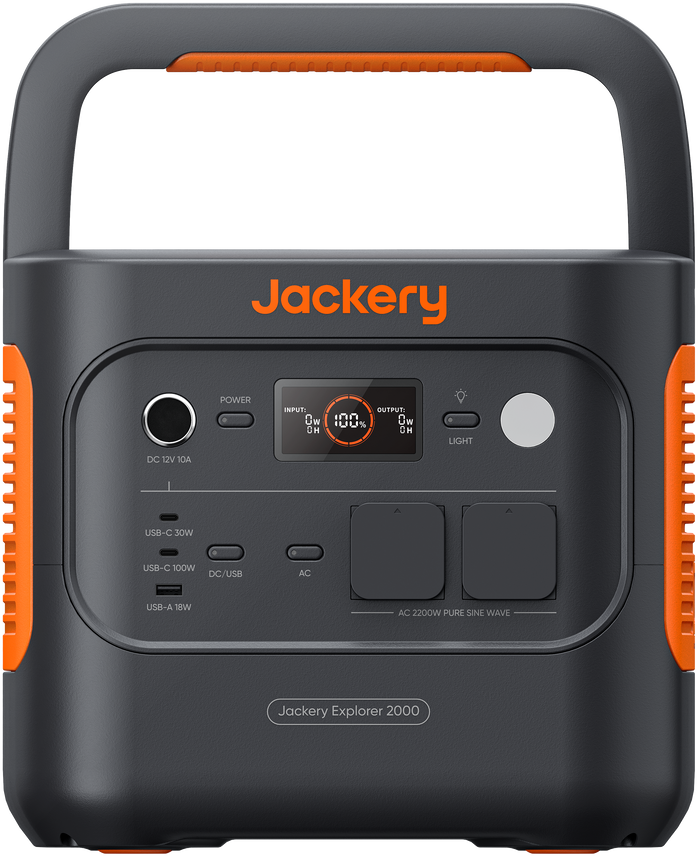
Jackery Explorer 2000 v2
Main strength
Some fields have documentary evidence; consult the field list and sources. Other specifications and compatibility remain pending.
We have not yet established a main strength for your use case.
Last documentary review
Official sources reviewed: 2026-10-26. EU/ES JE-2000D documented at 230 V/50 Hz; retail UPC equals the official ES GTIN. Covered outlets, count and type unverified; no observed Schuko claim. We have not carried out physical tests.
Who it may suit
We need to check your appliances against the model’s evidence before saying who it suits. Start by calculating your consumption.
When to look elsewhere
Do not choose it if you need confirmed compatibility and information about your load or the station is still missing. Missing information is not a proven limitation.
Main trade-off
A documented interpretation of this model’s trade-offs is still needed. We do not infer portability, runtime or ease of connection from isolated figures.
What we know
Fields with documentation: nominal capacity, continuous AC power, chemistry, dimensions, maximum solar input, solar input conditions, number of USB ports, DC/USB output limits, connection features, app conditions, EPS/UPS transfer time. Each field retains its limits; this does not verify the whole model.
View sources and variant ↓What needs checking
Your setup still needs checking: startup, cables, ports and simultaneous use, operating conditions and solar installation. The offer, package contents, final price and availability are checked separately.
Next step: check your consumption and appliance connections; nominal capacity alone does not establish compatibility.
- Nominal capacity
- 2042 Wh
- Continuous AC power
- 2200 W
- Weight
- Documentation pending
- Maximum solar input
- 400 W
Connections: documented ports, voltages and limits ↓
Documented limits of the reviewed variant. Port power does not guarantee your appliance's protocol, cable or start-up. Shared groups limit the sum of loads.
1 × USB-C1 30 W; protocol and combined limit unverified · up to 30 W per port
5 / 9 / 12 / 15 / 20 V. Up to 3 A. Required accessory: Verify protocol, negotiation, cable and the combined limit before using the individual maximum; electrical profiles alone do not establish a protocol..
USB-PD profile table remains undocumented; a port's maximum does not establish that power at every voltage.
Documentary limits reviewed: 2026-10-13; these are not physical tests.
European manual for Jackery Explorer 2000 v2 (PDF) · USB-C1 30 W; protocol and combined limit unverified ↗1 × USB-C2 100 W; protocol and combined limit unverified · up to 100 W per port
5 / 9 / 12 / 15 / 20 V. Up to 5 A. Required accessory: Verify protocol, negotiation, cable and the combined limit before using the individual maximum; electrical profiles alone do not establish a protocol..
USB-PD profile table remains undocumented; a port's maximum does not establish that power at every voltage.
Documentary limits reviewed: 2026-10-13; these are not physical tests.
European manual for Jackery Explorer 2000 v2 (PDF) · USB-C2 100 W; protocol and combined limit unverified ↗1 × USB-A up to 18 W across voltage bands; 5 V power and protocol unverified · up to 18 W per port
Voltage documentation pending. Current documentation pending. Required accessory: Do not discretize the 5–6 V/3 A, 6–9 V/2 A and 9–12 V/1.5 A bands as an 18 W profile at 5 V. Protocol and negotiation remain unverified..
Documentary limits reviewed: 2026-10-13; these are not physical tests.
European manual for Jackery Explorer 2000 v2 (PDF) · USB-A up to 18 W across voltage bands; 5 V power and protocol unverified ↗1 × 12 V/10 A car socket: derived 120 W · up to 120 W per port
12 V. Up to 10 A.
Documentary limits reviewed: 2026-10-13; these are not physical tests.
European manual for Jackery Explorer 2000 v2 (PDF) · 12 V/10 A car socket: derived 120 W ↗
Charging and power: conditions that change the decision ↓
- Mains recharge of the whole battery
- Charging verification pending. This is a manufacturer claim under its stated conditions, not our own measurement. It is not the time to replenish your daily consumption.
- Solar input
- The manual describes DC input at 11–16 V/8 A total and 16–60 V/12 A through one input or 21 A combined, up to 400 W. For solar, the FAQ lists 16–60 V and a maximum of 200 W per port or 400 W combined. The exact 16 V boundary, panel Voc/Isc, polarity and cable remain unknown. Manual/FAQ spell the connector DC2820/DC8020 differently. Parallel ports require identical panels or equal power/Voc/Vmp; with both ports active, equal counts per port and 1/2/4-panel configurations, not 3; suitable adapters remain unverified. A shared connector does not approve a connection. Peak sun hours describe equivalent energy, not clock hours at constant maximum power.
- Start-up and special modes
- Transient peak verification pending. Special modes may reduce voltage; they do not replace continuous power.
- Power supply continuity
- UPS: up to 20 ms; check your load. An EPS/UPS function with interruption does not establish medical continuity or compatibility with all sensitive equipment.
What do watts and watt-hours represent?
The W describe power at a given moment; Whdescribe accumulated energy. Multiplying an appliance's power by its usage hours estimates energy: 100 W for 2 hours is 200 Wh consumed by the appliance. Losses mean the battery must supply more.
Phone or tablet: 15 W × 2 h = 30 Wh
Illustrative load; check charger and USB protocol.
Router: 12 W × 8 h = 96 Wh
Hypothetical constant power; confirm the power supply.
LED light: 10 W × 4 h = 40 Wh
Example of one light; add the others if used simultaneously.
Compressor fridge: 45 W × 4 h = 180 Wh
Four hours of compressor operation, not four clock hours or measured consumption.
Illustrative power and hours, not measurements of your appliances or verified runtime of this station. These Wh represent appliance consumption before losses. Check each appliance's port, voltage, protocol and start-up requirements.
Formulas and assumptions for the AC example ↓
In the example of 100 W for 2 hours, the battery would supply around 265 Wh: AC consumption ÷ 85% efficiency, plus 15 illustrative inverter watts over those two hours.With90% of the2042documented nominal Wh available, such a constant load would give approximately13.9 hours. Formula: capacity ×0.9 ÷ (100 ÷ 0.85 + 15).
Battery margin, losses and inverter consumption are planning assumptions, not measurements of this model. Temperature, ageing and variable consumption may change the result. Do not apply this AC example directly to USB or DC.
400 W of panels: generation and solar example ↓
This is nominal generation power. With 4 peak sun hours and 75% assumed solar efficiency, the example is 400 W × 4 PSH × 0.75 = 1200 Wh. This is energy equivalent to six uses of the 100 W, two-hour example before output losses, not six guaranteed uses.
ForJackery Explorer 2000 v2, also applying the documented solar maximum limits the example's power to400W and its indicative calculation to1200Wh.Four PSH do not mean four clock hours at a constant 400 W. Voltage, current, connectors, accessories and actual conditions must be checked; clouds or an incompatible input will change the energy. This figure is not a whole-battery recharge time either.
Enter your appliances and days to replace these examples with your own case.
Calculate my needs →Sources, documented fields and review date ↓
Model: Explorer 2000 v2 JE-2000D; ES SKU 21-0001-000267 / GTIN 810105528466, distinct from 2000 Plus JE-2000C and Pro JE-2000A. Region: EU/ES JE-2000D documented at 230 V/50 Hz; retail UPC equals the official ES GTIN. Covered outlets, count and type unverified; no observed Schuko claim.. Review date: 2026-10-26. Established fields: nominal capacity, continuous AC power, chemistry, dimensions, maximum solar input, solar input conditions, number of USB ports, DC/USB output limits, connection features, app conditions, EPS/UPS transfer time. This review does not establish price, stock, ASIN, warranty applicable to your purchase or physical testing.
Specific outstanding checks.
- Commercial variant bound by UPC 810105528466 to ES SKU 21-0001-000267 and the EU JE-2000D manual. Keep outlets and weight unknown because of the 2/3 and 17.5/17.9 kg discrepancies; closed covers do not prove Schuko sockets. Warranty, cycles under verified conditions, usable energy, price and reviews remain unverified.
- EU JE-2000D: documented 230 V/50 Hz and normal 2200 W total AC output. The 4400 W figure is a peak without an established duration and does not prove startup. Confirm socket type/count, actual frequency, appliance and settings before relying on the output; do not add individual limits or guarantee medical loads.
- Individual USB and car limits do not establish a combined DC maximum or an AC+DC sum. Each USB-C protocol remains unknown; electrical profiles do not guarantee USB-PD negotiation. USB-A 18 W does not imply 18 W at 5 V. Check cable, polarity, voltage and the actual load.
- ECO defaults on: after 12 h without a device or with low loads, the manual describes all outputs turning off at thresholds of 25 W AC and 2 W USB/car. Mixed-load logic and actual settings remain unverified. AC+power can disable it; this is not a universal 12-hour shutdown. Main shutdown after 2 h without charging/discharging and the 2-minute display timeout are separate timers.
- 20 ms UPS is a claim, not 0 ms or measured switching. The manual recommends one device and excludes equipment with high continuity requirements such as servers; test the appliance. Bypass: the manual gives 220–240 V/50 Hz/10 A without an explicit W maximum, versus 2200 W in the FAQ. Do not promise 2200 W while recharging or medical continuity.
- The manual describes DC input at 11–16 V/8 A total and 16–60 V/12 A through one input or 21 A combined, up to 400 W. For solar, the FAQ lists 16–60 V and a maximum of 200 W per port or 400 W combined. The exact 16 V boundary, panel Voc/Isc, polarity and cable remain unknown. Manual/FAQ spell the connector DC2820/DC8020 differently. Parallel ports require identical panels or equal power/Voc/Vmp; with both ports active, equal counts per port and 1/2/4-panel configurations, not 3; suitable adapters remain unverified. A shared connector does not approve a connection.
- Charging: manual 0–45°C versus FAQ 0–40°C, without a reconciled canonical range; discharge -10–45°C. Battery-saving mode reduces usable energy; SOC and actual state remain unverified. Emergency charging should not be used routinely for long periods. Do not turn the FAQ’s 18 W standby into a fixed engine consumption or promise recharge times.
Power station only: solar panels are not included. Package contents checked on 2026-10-26. Check that the same variant is still selected when buying.
Check variant and store conditions ↗
Price awaiting verification
Shop awaiting verification · Jackery Explorer 2000 v2: confirm the European variant and package contents · Pending
Verification pending: European variant price, shop, date, taxes, delivery and terms. The old catalogue reference is not used for sorting, budget filters or €/Wh calculations.
Price and conditions can change. The date shown is the latest identity check of the new European variant, not a guarantee of current price, stock, seller or condition. After seven days the link remains available with an older-review warning. Confirm all these details before buying. Commercial attribution remains unverified.
Affiliate link: we may receive a commission if your purchase qualifies, at no extra cost to you.
Explorer 2000 v2 JE-2000D, distinct from the 2000 Plus. Official sources disagree between 2 and 3 AC outlets and between 17.5 and 17.9 kg; the photos show closed covers. Confirm the unit outlets and weight before buying. The advertised 4,400 W does not establish startup capability or replace normal 2,200 W output. Continuity is not guaranteed.


A new-condition offer for this model still needs checking.