
Documentary comparison
EcoFlow DELTA 2 vs Bluetti AC180
AC180 adds 12.5% nominal capacity compared with DELTA 2, with the same 1,800 W AC power. AC180's weight requires resolving the official 16/17 kg discrepancy. Both accept up to 500 W solar, but their electrical windows differ. There is no universal winner or established camper endorsement.
We have not carried out physical tests. Catalogue differences do not establish compatibility with your appliances, quietness or a current offer.
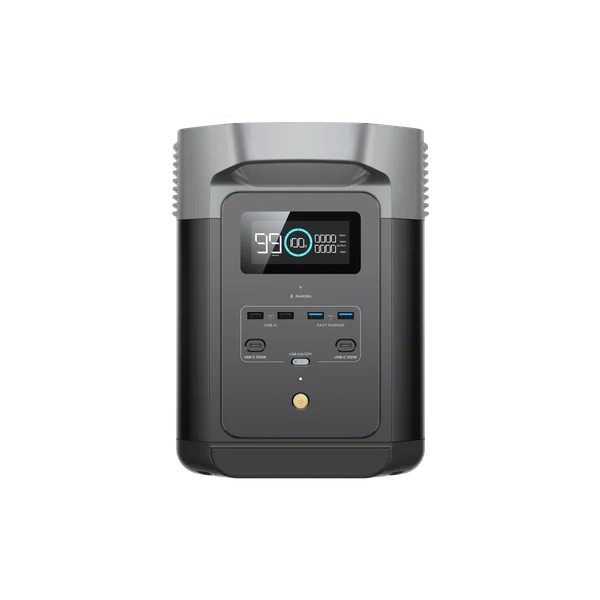
Consider EcoFlow DELTA 2 if…
You often transport the station and its 12 kg suit you. Its two 100 W USB-C ports may matter for two compatible devices. We do not establish an exact weight difference with AC180.
See connections and limits →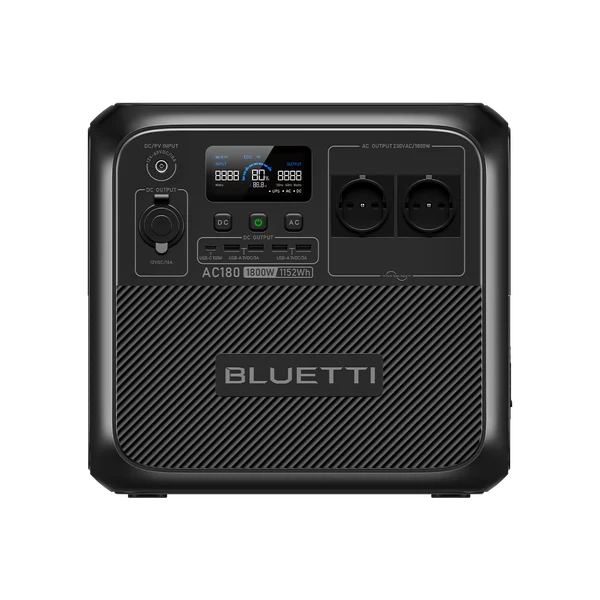
Consider Bluetti AC180 if…
You prefer 128 more nominal Wh and can confirm your unit's weight: the official page mixes 16 and 17 kg. Continuous AC power is the same: 1,800 W.
See connections and limits →Compare the same data, with its conditions.
An input maximum is not a charging time. A peak is not continuous power. Pending cells do not support a conclusion of superiority.
| Data | EcoFlow DELTA 2 | Bluetti AC180 |
|---|---|---|
| Nominal capacity | 1024 Wh | 1152 Wh |
| Continuous AC power | 1800 W | 1800 W |
| Weight | 12 kg | Documentation pending |
| DC and USB | 1 × 12.6 V vehicle socket: 126 W (shared group 126 W) · 2 × 12.6 V DC5521: 38 W (shared group 126 W) · 2 × 100 W USB-C PD: 100 W · 2 × 12 W USB-A: 12 W · 2 × 18 W USB-A fast charging: 18 W | 1 × 12 V vehicle socket: 120 W · 1 × 100 W USB-C PD: 100 W · 2 × USB-A group 1: 15 W shared: 15 W (shared group 15 W) · 2 × USB-A group 2: 15 W shared: 15 W (shared group 15 W) |
| Solar maximum | 500 W | 500 W |
| Solar conditions | Solar input: 11–60 V, 15 A and 500 W maximum. Requires an MC4-to-XT60/XT60i cable suitable for the panel; verify Voc, current and polarity before connecting. | DC7909 input: 12–60 V, 10 A and 500 W maximum. MC4-to-DC7909 solar cable; check the array’s open-circuit voltage and do not confuse it with the DC output socket. |
| Mains: 0–100% | 80 min (0–100%) | 78–108 min (0–100%) |
| Mains: 0–80% | Battery range and mode documentation pending | Battery range and mode documentation pending |
Evidence for EcoFlow DELTA 2
2026-10-08 · DELTA 2, European manual; not DELTA 2 Max · EU, 230 V
Official source 1 ↗Official source 2 ↗Official source 3 ↗Official source 4 ↗Evidence for Bluetti AC180
2026-10-08 · AC180-EU 1152 Wh; not AC180P · EU, 230 V
Official source 1 ↗Official source 2 ↗Official source 3 ↗Official source 4 ↗Before deciding.
Which offers more runtime?
At equal consumption and efficiency, 1,152 Wh offer more nominal energy than 1,024 Wh. We have not measured either unit's usable energy: use the calculation as guidance and check ports and appliance consumption.
Can charging speed be compared directly?
Compare the same battery range and mode. DELTA 2 declares 50 minutes from 0 to 80%; AC180 declares 45 minutes in fast mode. Full times are shown separately with their conditions; these claims are not our own measurements or proof of superiority in every use.
Do 2,700 W modes increase continuous power?
No. Distinguish a transient peak from X-Boost or Power Lifting and from 1,800 W nominal power. Special modes have load and voltage restrictions; they do not establish universal compatibility with coffee machines, induction or electronics.